Fix Your Knowledge Management Before You Add AI
There’s a pattern we see again and again. An organisation gets excited about AI, buys a platform, feeds their documents into it, and asks it a question. The answer comes back confident, articulate, and completely wrong.
The problem isn’t the AI. The problem is what it was given to work with.
The garbage-in problem
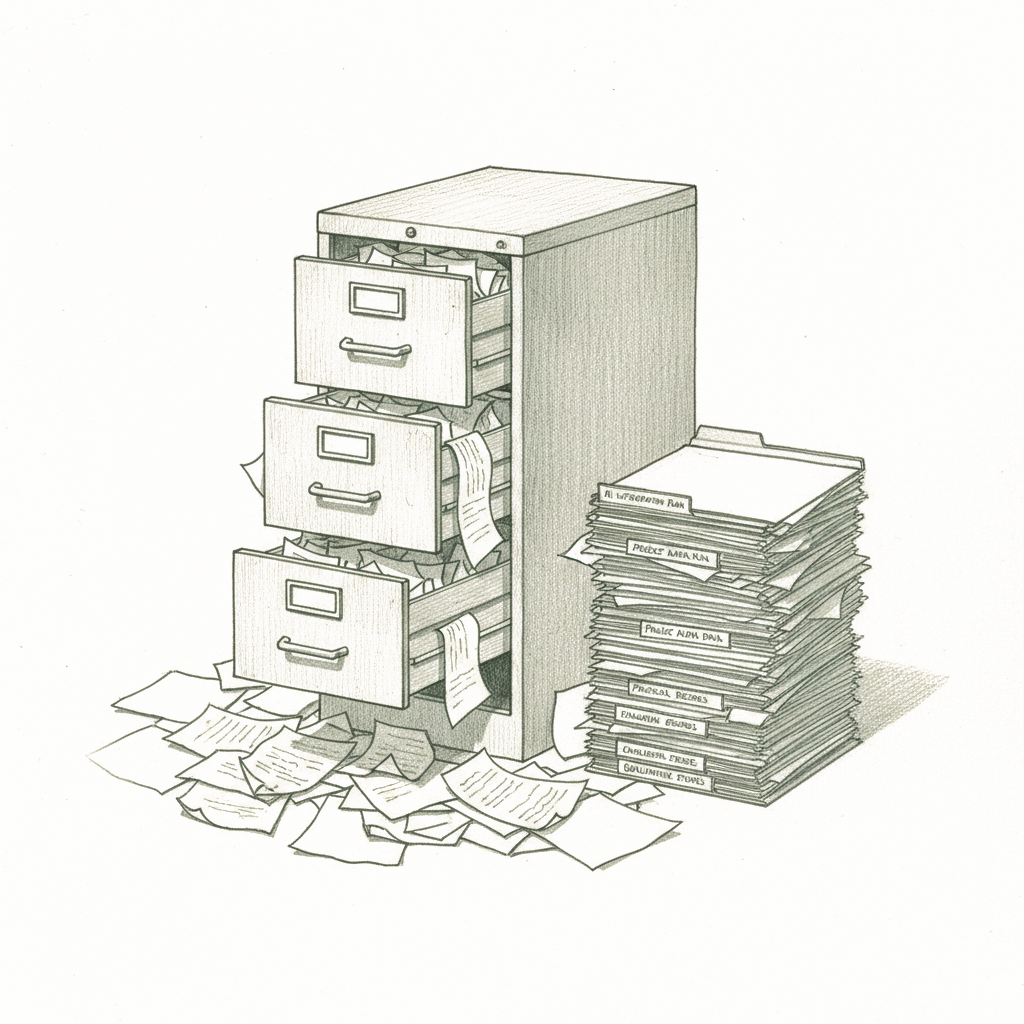
Most businesses have years of accumulated documents, guides, and records. Some are current. Some were last updated in 2019. Some directly contradict each other. Some are duplicates with slightly different versions. And the critical stuff? It often only exists as knowledge in someone’s head.
When you point AI at this mess, it treats everything equally. It doesn’t know that the 2019 process guide was replaced. It doesn’t know that the version in SharePoint is the wrong one. It just pattern-matches across everything it was given and serves up an answer. A confident, well-written, completely unreliable answer.
This is why knowledge management has to come before AI — not after it.
What “getting your house in order” actually looks like
Find out where knowledge actually lives
Not where it’s supposed to live — where it actually lives. In most organisations, the answer is: everywhere. Email threads, shared drives, someone’s desktop, a Slack message from six months ago, a whiteboard photo someone took and never filed.
Map it. Don’t judge it yet — just find it. You’ll probably be surprised at how scattered it is.
Identify what’s current and what’s a zombie
Old documents aren’t just useless — they’re actively harmful. They mislead people. They mislead AI even more, because AI doesn’t have the context to know that the “Process Guide v2.3” was superseded two years ago.
Go through what you have. If it’s current, mark it. If it’s outdated, either update it or remove it. A smaller, accurate knowledge base is vastly more valuable than a large, unreliable one.
Give every document an owner
If nobody is responsible for keeping a document current, it will rot. Every piece of important knowledge should have a named person who is accountable for reviewing and updating it. Not a team — a person. Teams don’t update documents. People do.
Standardise how you structure information
This one seems small but it matters enormously. If your documents use consistent headings, clear titles, and a predictable structure, both people and AI can find what they need much faster.
You don’t need a complicated taxonomy. You need: a clear title, a date, an owner, and a consistent format. That’s it.
Get the tribal knowledge written down
This is the hardest step and the most important one. Every organisation has critical knowledge that exists only in people’s heads. The person who knows how the billing exceptions work. The person who remembers why that client has a special arrangement. The person who keeps the production system running with undocumented workarounds.
When those people leave — and they will — that knowledge leaves with them.
Start small. Pick the three most critical processes that only one person understands. Get them documented. Then do three more.
Then — and only then — consider AI
Once your knowledge base is clean, current, and structured, something remarkable happens: you don’t even need fancy AI to make it useful. Good search, clear structure, and up-to-date content solve most knowledge problems on their own.
But if you do add AI — a retrieval system, an internal chatbot, an automated assistant — it actually works. Because it’s drawing from information you can trust.
The difference between AI searching a clean knowledge base and AI searching a mess isn’t marginal. It’s the difference between a useful tool and an expensive liability.
The real investment
Getting your knowledge in order isn’t a quick fix. It takes time, attention, and honest assessment. It’s not as exciting as buying an AI platform and showing the board a demo.
But it’s the foundation that makes everything else work — AI or otherwise. And unlike a software subscription, the benefits compound. Every document you clean up, every process you capture, every piece of tribal knowledge you write down — it stays valuable whether you add AI or not.
Start with the knowledge. The AI will still be there when you’re ready for it.